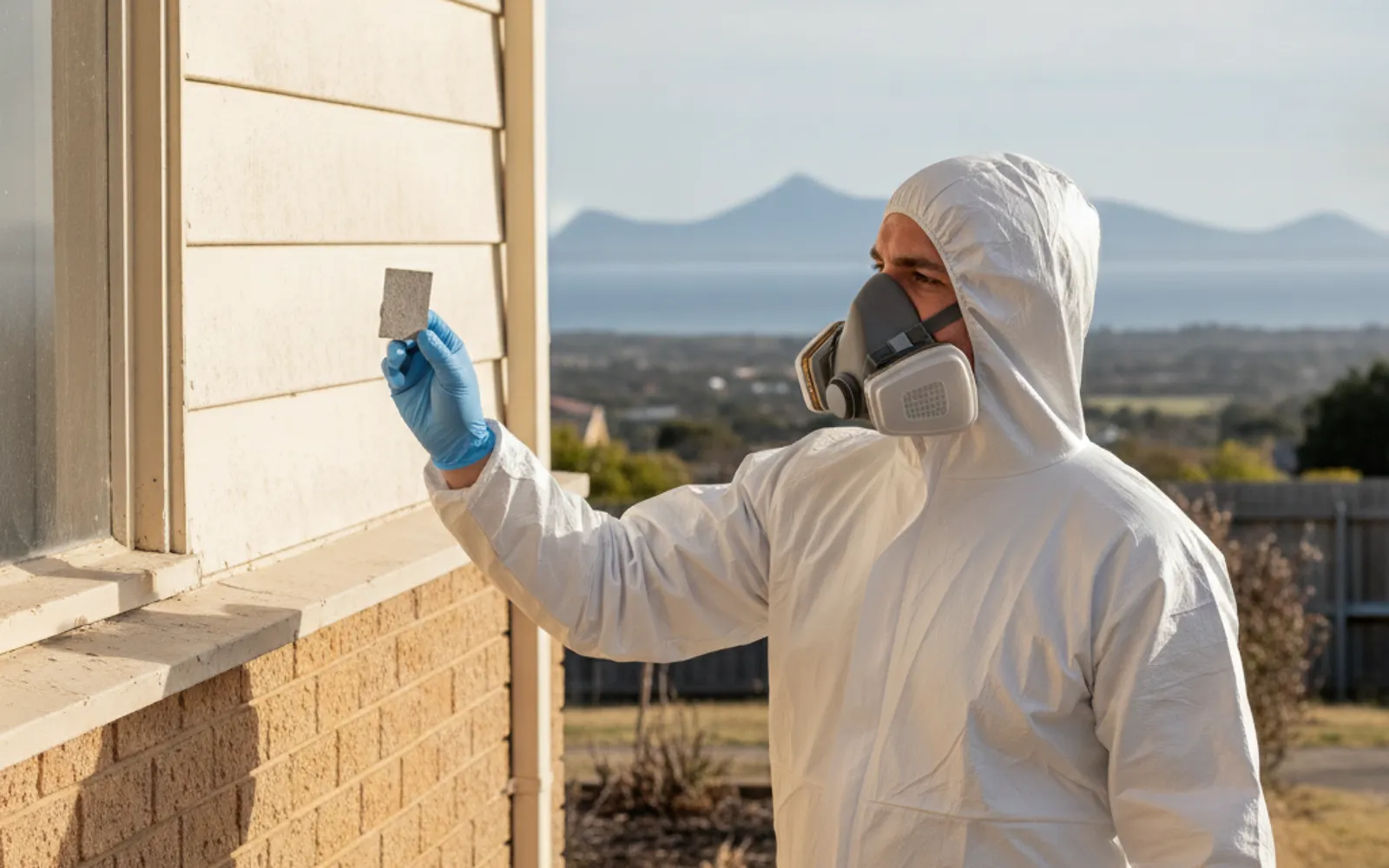
You cannot tell asbestos from ordinary fibre cement by looking at it. A small sample, analysed by a NATA-accredited laboratory, gives you a straight answer before you pick up a tool.
Asbestos testing in Geelong answers the question that has to come first: is the material actually asbestos? You cannot settle that from the colour of a sheet, the look of a fence, or the age of the house. Under Victoria's OHS Regulations, only a laboratory approved by NATA can analyse a sample and identify asbestos. A test is the honest first step, not a formality.
It is also the cheap step. Victorian and national labs publish $88 to $160 per sample, and most houses need three to eight samples, because every different material has to be tested separately. A negative result means you get on with the job. A positive one means you know what you are dealing with before anyone picks up a grinder, and we can put you in touch with licensed asbestos removalists who quote the work themselves. Call now and get it tested before you touch it.
A fence, an eaves lining and a bathroom wall sheet are three samples, not one. Most houses need three to eight, and larger properties can run to eight or twelve.
Victoria's OHS Regulations allow only an approved asbestos laboratory to identify asbestos in a sample. Endorsed reports carry the NATA insignia, and you can check any lab at nata.com.au.
That is the standard turnaround Victorian and national labs publish. A 24 to 48 hour result is usually available for a surcharge of 25% to 50%.
The report states whether asbestos was detected in the sample submitted and what type it is. It is a document you can hand to a builder, a buyer or a removalist.
Lab analysis runs $88 to $160 per sample. An on-site inspection with sampling is a Melbourne-metro benchmark of $395 to $900, and there is no published Geelong rate anywhere.
If it comes back positive, we put you in touch with licensed asbestos removalists. Their WorkSafe Victoria licence number appears on every quote, and you deal with them directly.
Asbestos cement was first manufactured in the 1920s and was standard in Australian residential building from the mid-1940s until the late 1980s. The total ban on the manufacture, supply, use, import, transport and sale of all forms of asbestos only came into force on 31 December 2003. A sheet fixed to a house anywhere in that span might contain asbestos and might not, and nothing on its surface tells you which.
Age is a guide, not a test. The Victorian Government's position is that homes built in Australia until 1990 routinely used asbestos products such as cement sheeting and pipe insulation, and that asbestos is estimated to still be present in one in three homes. That is a national estimate. No figure has ever been published for Geelong or the Barwon region, so be wary of any site that gives you one.
The regional history still matters. Geelong's northern suburbs were built in bulk inside that window: the Housing Commission's Norlane program peaked between 1951 and 1957 and had delivered 2,464 houses by 1976, and Corio gained five estates of about 2,500 houses from the late 1950s. Ford at Norlane, the Shell refinery from 1956 and Alcoa at Point Henry from 1963 were the employers who filled them. Nobody has ever counted how many of those houses still hold asbestos, so a sample beats a guess every time.
Under the OHS Regulations, only an approved asbestos laboratory can analyse samples to identify asbestos, and approved means approved by NATA or under a scheme determined by WorkSafe. That is what identification legally means in this state. A confident opinion from a tradesperson, a neighbour or a photo on a forum is not the same thing as a result.
The process is simple enough. Each material that could be asbestos cement is sampled separately, because a laboratory result only ever applies to the sample it came from. If you want a rough sense of scope before you call, count the distinct materials rather than the rooms: wall sheeting, an eaves lining, a fence, a shed wall and a roof sheet are five different tests.
Prices are indicative and GST treatment varies between providers, so ask each one whether their quote includes GST. None of these are our figures. They are what the market publishes, set down here so you know roughly what you are walking into. Removal costs are a different order of number, and you can see the ranges on our asbestos removal cost page.
A laboratory report is narrower than most people expect. It states whether asbestos was detected in the sample submitted, and if it was, which type. It says nothing about the condition of the rest of your roof, and nothing at all about a material that was never sampled. That narrowness is the point: it is a fact about a specific piece of your house, which is what a builder, a buyer or a removalist needs.
An endorsed report carries the NATA insignia, and you can confirm any laboratory's approval on the NATA website at nata.com.au. Barwon Asbestos Co is not a laboratory and is not NATA-accredited. The sample is analysed by an accredited lab and the report comes back in their name.
One piece of Victorian vocabulary is worth knowing, because plenty of content online borrows interstate terms that mean nothing here. The person who does airborne fibre monitoring, the visual inspection after removal and the clearance certificate is an independent person, and they have to be independent of whoever did the removal and whoever paid for it. That role belongs at the end of a removal job. Working out what your fence is made of belongs to a laboratory.
In most cases a positive result is not an emergency. Asbestos cement in sound condition and left alone is a different situation from a sheet that has been cut, drilled, water-blasted or smashed. What changes is that the material now has rules attached to it.
Nearly all residential material around Geelong is non-friable: fibro cladding, fences, Super Six roofing, eaves, shed and garage sheeting. Above the threshold, removing it is Class B work. Friable material such as pipe lagging or crumbling, fire-damaged sheeting is Class A and always needs a licensed removalist, at any quantity, with no exemption.
The figure you will see quoted is 10 square metres, and it comes with a second cap that usually gets left off: no more than one hour of asbestos removal work in any seven day period, counted cumulatively across jobs rather than per job. Both caps have to hold. Those regulations bind employers and self-employed people at workplaces, and your own home is not a workplace, so nobody should tell you that exceeding them at your house is illegal. WorkSafe recommends homeowners follow the same code anyway, the caps become law the moment a tradesperson, tenant, rental property or paid helper is involved, and a full fence line, a garage or a house roof is well past both of them regardless.
Hand the job to a licensed removalist and some of the paperwork stops being yours. Where a homeowner engages the removalist at a domestic property, the duty to obtain the clearance certificate sits with the licence holder, and no clearance certificate is required at all if the work was only non-friable material of 10 square metres or less. The removalist also notifies WorkSafe before starting, at least 24 hours ahead for 10 square metres or less of non-friable material and at least five days ahead for anything bigger, so a job rarely starts tomorrow. We will put you in touch with licensed removalists and you contract with them directly, whether it turns out to be fence removal, roof and shed removal or disposal at a licensed facility.
Victorian and national laboratories publish $88 to $160 per sample, and most houses need three to eight samples because each material is tested separately. An on-site inspection with sampling runs $395 to $900, though that is a Melbourne-metro benchmark and no Geelong rate is published anywhere. Prices are indicative and GST treatment varies between providers, so ask each one whether their quote includes GST.
Standard turnaround is 1 to 5 business days from the day the laboratory receives the sample. If you need it sooner, labs commonly add 25% to 50% for a result inside 24 to 48 hours. Weekends generally do not count, so a Friday sample often means a Monday result.
No. Asbestos cement was standard in Australian homes from the mid-1940s until the late 1980s, and homes built until 1990 routinely used it, so a 1960s Geelong house sits squarely in the window. Nationally, asbestos is estimated to still be present in one in three homes, and there is no published figure for Geelong or the Barwon region. Age on its own is never a test, and that is the whole reason sampling exists.
It depends on the material and the amount. Friable asbestos always needs a Class A licensed removalist, at any quantity, with no exemption. For non-friable material the limit the law sets for anyone doing this as work is 10 square metres and no more than one hour of removal work in any seven day period, and both caps must hold. Those regulations do not bind you at your own home, but WorkSafe recommends following the same code, and they become law as soon as a tradesperson, tenant, rental property or paid helper is involved.
A laboratory approved by NATA, which is what Victoria's OHS Regulations require: only an approved asbestos laboratory may analyse samples to identify asbestos. Endorsed reports carry the NATA insignia, and you can check a lab's approval at nata.com.au. Barwon Asbestos Co is not a laboratory and is not NATA-accredited. The sample goes to an accredited lab and the report comes back in their name.
Free quotes from licensed removalists. Tell us what you've found and we'll put you in touch.