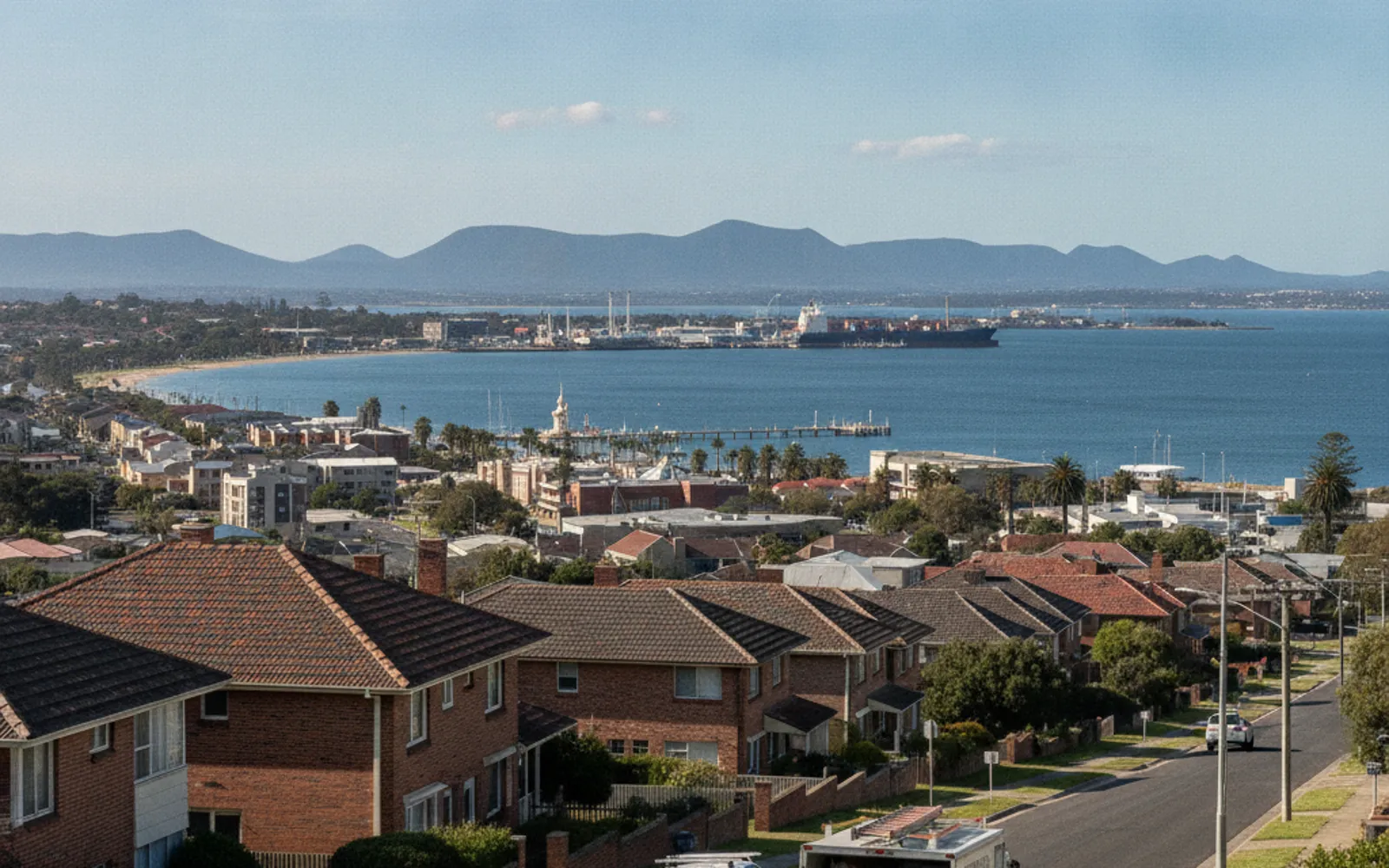
Geelong's post-war suburbs went up in the same decades asbestos cement was standard building material. If you've found sheeting you're not sure about, get it tested before you touch it.
Geelong's big housing boom and the asbestos cement era are the same stretch of years. The Housing Commission's Norlane program peaked between 1951 and 1957 and had put up 2,464 houses by 1976, and Corio gained five estates of roughly 2,500 more from the late 1950s. Asbestos cement was standard residential building material from the mid-1940s until the late 1980s, so sheeting on a fence, an eaves lining or a garage wall from that era is worth checking before anyone puts a tool through it.
We don't hold a removal licence and we don't claim one. What we do is take samples and have them analysed, then put you in touch with licensed asbestos removalists working across Greater Geelong, the Bellarine Peninsula, the Surf Coast and Golden Plains. You contract with the removalist directly, and their WorkSafe Victoria licence number appears on every quote. If something has already been cracked or broken, call 0480 XXX XXX and start with a test rather than a guess.
You can't tell fibro from modern fibre cement by looking at it, and an older Geelong house often has three or four different materials in play. We take the samples and a NATA-accredited laboratory does the analysis, usually back within one to five business days.
Old fibro boundary fences are the most common residential job in Geelong's northern suburbs, and a full fence line is well past what anyone is meant to take on unlicensed. The removal is carried out by licensed asbestos removalists we work with, and their WorkSafe Victoria licence number is on the quote.
Super Six roofing, garage and shed cladding and eaves linings are the bigger jobs, and the ones where sheets must never be water-blasted, drilled, dry-swept or walked on. A licensed removalist prices the removal itself; whatever goes back on afterwards is something you arrange separately with a registered builder.
Asbestos is reportable priority waste in Victoria and can only go to a landfill authorised to receive it, never into a general skip or a council hard-waste collection. In the whole Barwon region that means Drysdale, which takes small domestic loads only, so ring (03) 5251 2935 before you drive out.
Geelong's northern suburbs were built by industry, and they were built fast. Ford's Norlane complex went up in stages between 1925 and 1942, and by the company's fiftieth anniversary in 1953 Ford was Geelong's biggest employer with over 5,000 workers. The Housing Commission built to match, and much of that housing went to Ford, International Harvester and phosphate works employees.
Corio went the same way. Five Commission estates of about 2,500 houses went up there from the late 1950s over roughly twenty years, alongside the Shell refinery in 1956 and Alcoa's Point Henry smelter, which poured its first ingot in April 1963. Corio's population was 857 in 1947 and 15,342 by 2001, so the growth there is almost entirely post-war.
Put those dates next to the material and the point makes itself. Asbestos cement was common in Australian residential building from the mid-1940s until the late 1980s, and homes built up to 1990 routinely used it. None of that tells you what is in your particular house, and nobody has published a figure for how much of Geelong's housing stock actually contains asbestos. What it does tell you is that a pre-1990 house here was built inside the window, which is reason enough to test before you cut into anything.
This is the part most asbestos pages get wrong, so it's worth stating carefully. For anyone doing this as work, Victoria's OHS Regulations cap unlicensed removal at 10 square metres of non-friable material, and at no more than one hour of removal work in any seven-day period. Both caps have to hold, and that hour is cumulative across jobs rather than per job.
Those regulations bind employers and self-employed people at workplaces. WorkSafe's compliance code says plainly that they don't apply to someone removing asbestos at their own home, because a home isn't a workplace, and it recommends homeowners follow the same code anyway. Bring in a tradesperson, a tenant, a rental property or a paid helper and the caps become law.
In practice the numbers decide it for you. A full fence line, a garage or a house roof is far past 10 square metres and far past an hour, so it's licensed removalist work either way. Friable material, meaning anything crumbling, fire-damaged or used as pipe lagging, is Class A work and always needs a licensed removalist at any quantity. If you're not sure which you've got, testing is the cheapest step in the whole process.
Start with the honest caveat: nobody publishes Geelong or Barwon asbestos prices. The figures below are Melbourne-metro benchmarks, and two of the Melbourne suppliers behind them price regional work separately, so treat them as a shape rather than a quote. Prices are indicative and GST treatment varies between providers, so ask each removalist whether their quote includes GST.
The most useful number is the minimum job charge, which runs from $800 to $1,500. That's why a two-sheet repair doesn't cost two sheets' worth: the setup, the wrapping, the tip run and the paperwork are much the same whether the job is small or large. Whole fences sit in the $1,000 to $3,500 band, a house roof runs $4,000 to $15,000, a garage or small roof $3,500 to $5,500, and general removal works out at $45 to $150 per square metre.
Testing is the cheap end of it. A lab sample runs $88 to $160, most houses need three to eight samples because every different material has to be tested separately, and a full on-site inspection with sampling sits between $395 and $900. Standard lab turnaround is one to five business days, with a 25% to 50% surcharge if you need a result inside 24 to 48 hours. There's a fuller breakdown on the cost guide.
Drysdale Landfill is the only facility in the Barwon region on EPA Victoria's register of landfills licensed for asbestos waste. It takes small domestic quantities only, up to a 6x4 trailer load, and fees apply. Ring (03) 5251 2935 before you go, because an authorised landfill can still choose not to accept a load and you may need to book a time. None of the Surf Coast Shire transfer stations accept asbestos, so a Torquay or Anglesea load has to come to Drysdale as well.
Possibly, and it's worth testing rather than assuming. The Norlane Commission program peaked in 1951 to 1957 and reached 2,464 houses by 1976, and Corio gained five estates of about 2,500 houses from the late 1950s, which lands squarely in the period when asbestos cement was standard. Nobody publishes a figure for how many Geelong houses actually contain it, so the honest answer is that a home built or extended before 1990 may have it and a lab sample settles the question.
The 10 square metre limit, and the rule about no more than an hour of removal work in any seven days, is what the law sets for anyone doing this as work. Your own home isn't a workplace, so those caps don't bind you there, although WorkSafe recommends homeowners follow the same code anyway. The moment a tradesperson, a tenant, a rental property or a paid helper is involved, they are law. A full boundary fence is well past both caps regardless, which is the practical reason those jobs go to a licensed removalist.
Not always. A clearance certificate isn't required where the work involved only non-friable material and came to 10 square metres or less in total. Above that, one has to be obtained before the area is re-occupied, and where you engaged the licence holder yourself for work at your own home, the duty to obtain it sits on the removalist rather than on you. It has to come from an independent person with no interest in the job, which is why it shows up as a separate line on a quote.
Free quotes from licensed removalists. Tell us what you've found and we'll put you in touch.