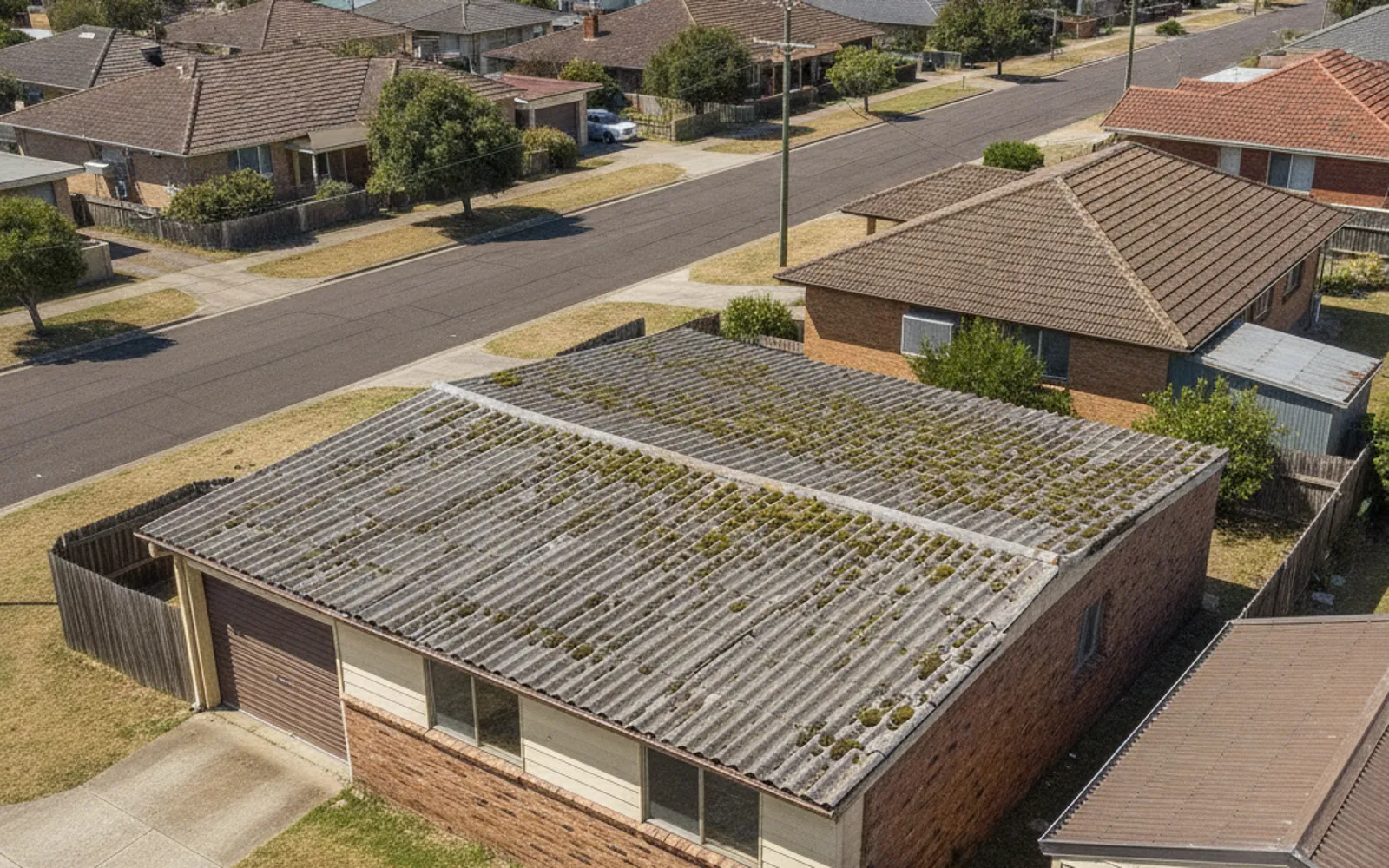
Super Six roofing, garage and shed cladding and eaves, taken off by licensed asbestos removalists working across Greater Geelong, the Bellarine, the Surf Coast and Golden Plains. Get it tested before you touch it.
Asbestos roof removal in Geelong usually starts with something small. Someone goes up to clear the gutters, or a storm cracks a sheet, and the grey corrugated roofing on the house or the back shed suddenly looks like a problem. On a Geelong house that roofing is almost always Super Six or a similar asbestos cement profile, which was standard here from the mid-1940s through to the late 1980s.
Intact, it is non-friable, and that is the good news. The trouble starts when someone treats it like tin. We are not a removalist and we hold no licence. What we do is put you in touch with licensed asbestos removalists working in the Barwon region, and their WorkSafe Victoria licence number appears on every quote they give you. You contract with them directly. Before any of that, the cheap and sensible first step is a sample: lab analysis runs $88 to $160 and settles the question in one to five business days.
The grey asbestos cement profile on thousands of Geelong houses, garages and carports. It comes off in whole sheets rather than being broken up, which is the whole point of doing it properly.
Roof and wall sheeting on detached garages and backyard sheds, including the ones that have been leaning for a decade. If you want the concrete slab out as well, that is a separate line at $60 to $180 per square metre.
Small in area, but they sit right under the roofline and they get disturbed by roof plumbers, solar installers and anyone chasing a leak. A full set of eaves runs $1,500 to $2,500.
A sample analysed at a NATA accredited laboratory costs $88 to $160. Most houses need three to eight samples, because the roof, the eaves and the shed wall are three different materials and each one is tested separately.
Non-friable roof sheeting is Class B asbestos removal work. Every removalist we put you in touch with holds a current WorkSafe Victoria licence, and the number is printed on the quote.
On a domestic job the licensed removalist has to obtain the clearance certificate, not you. The sheets go to a landfill authorised to receive asbestos, and in the Barwon region there is only one of those.
Asbestos cement is safe while the cement holding the fibres together stays intact. Almost every ordinary way of cleaning or repairing a roof breaks it. High pressure water blasting is the worst of them, because it strips the weathered top off the sheet and washes fibre-loaded slurry into the gutters, down the downpipes, through the garden beds and into the stormwater. You end up with a contaminated property rather than a clean roof.
The list of things that release fibres from a sound roof is short and worth knowing:
That last one deserves its own line. A sixty-year-old Super Six sheet will not reliably hold a person, and when it goes it goes without warning. That is a fall and a breakage in the same second, and it is the most common way a quiet asbestos roof turns into an expensive one. Licensed crews work from ladders, crawl boards and scaffolding for exactly that reason.
If something has already been broken or blasted, stop, keep people and pets away from the area, and do not hose it down. Get it tested before anyone decides what happens next.
Encapsulation means sealing the sheets with a coating so the surface stops shedding. It is a genuine approach and it suits some roofs, usually where the sheeting is still sound and the owner is not ready to replace it. Two things are worth understanding before you go looking for a price on it.
First, the asbestos is still there afterwards. Anyone who later works on that roof still needs to be told what is under the coating, it still limits what you can do to the building, and it still has to come off eventually. Sealing buys time. It does not close the file.
Second, the preparation is where people get into trouble. A coating needs a clean surface, and the obvious way to clean a roof is the one thing you must never do to this material. Surface preparation on asbestos cement belongs with people who are licensed and equipped for it, not with a hire-shop pressure washer on a Saturday.
We do not offer coating, painting, re-roofing or repairs. That is domestic building work and you arrange it separately with a registered builder or roofing contractor. What we can do is put you in touch with a licensed removalist who will quote the strip and the disposal, so you are comparing a real number against the cost of sealing rather than guessing.
The job starts before anyone is on site. A licensed removalist has to notify WorkSafe Victoria first: at least 24 hours ahead for work covering 10 square metres or less of non-friable material, and at least five days ahead for anything bigger. A house roof is always in the second group, and that notice period is the real answer to why nobody can start tomorrow.
On the day the pattern is much the same whether it is a house roof, a garage or a shed:
Two things people expect that usually do not apply here. Air monitoring is a Class A requirement, so a straightforward non-friable roof strip does not routinely get it. A clearance certificate is required once Class B work passes 10 square metres in total, which any roof will, and on a domestic job the licence holder carries that duty rather than the homeowner. Victoria also has its own terminology, so ignore what a New South Wales website tells you. Here the certificate comes from an independent person, who cannot be the removalist, an employee of the removalist, or anyone else with a financial interest in the job.
Nobody publishes a Geelong price for this. Every Victorian figure below comes from Melbourne suppliers' own rate cards and published guides, and two of those suppliers price regional work separately, so read them as benchmarks and not as a quote. Prices are indicative and GST treatment varies between providers, so ask each removalist whether theirs includes GST.
The minimum charge is the figure that catches people out. Four cracked sheets on a carport still involve the same notification, the same fall protection, the same wrapping and the same trip to the tip as forty, so small jobs land on the minimum. Our cost guide goes through the rest of it.
Where the sheets go is not optional either. Asbestos waste is classified as reportable priority waste and can only go to a landfill authorised to receive it, never a general skip and never a council hard waste collection. In the whole Barwon region there is exactly one authorised site: Drysdale Landfill, on (03) 5251 2935, small domestic quantities only up to a six by four trailer, and they want a call before you turn up. Surf Coast Shire says plainly that asbestos roofing sheets are not accepted at any of its transfer stations, so Torquay, Anglesea, Winchelsea and Lorne are all out. There is more on disposal and skip hire, and on the towns we cover from Geelong to Colac.
Victorian removalists publish $40 to $120 per square metre for roof sheeting, with a typical house roof landing between $4,000 and $15,000 and a garage or small roof between $3,500 and $5,500. Those are Melbourne-metro published rates, because no Geelong provider publishes prices at all. Small jobs hit a minimum charge of $800 to $1,500. GST treatment varies between providers, so ask whether the quote includes it.
The 10 square metre limit and the one hour in any seven days limit are what the law sets for anyone doing asbestos removal as work, and a house or garage roof is far past both. Those regulations do not technically bind you at your own home, because a home is not a workplace, but WorkSafe recommends homeowners follow the same code anyway. The moment a tradesperson, a tenant, a rental property or a paid helper is involved, the caps are law. Friable material always needs a Class A licensed removalist, at any quantity.
Pressure washing asbestos cement is about the worst thing you can do to it, because it erodes the weathered surface and carries fibres through the gutters, the downpipes and the garden. Painting needs surface preparation, which runs into the same problem. Sealing a sound roof is a real option, but the material stays on the property and still has to come off one day. We do not offer coating or re-roofing, and that is work you arrange separately with a registered builder.
A clearance certificate is required once Class B removal passes 10 square metres in total, which any roof does, and on a domestic job the licensed removalist has the duty to obtain it rather than you. It runs $165 to $250 and has to come from an independent person with no financial interest in the job, which is why it appears as a separate line on a quote. Air monitoring is a Class A requirement and does not routinely apply to a non-friable roof strip, though where it is needed it runs $250 to $600 a day.
You cannot tell by looking, and neither can anyone else, which is why testing is the honest first step. A sample analysed at a NATA accredited laboratory costs $88 to $160 and comes back in one to five business days, with a 25 to 50 per cent surcharge if you need it inside 24 to 48 hours. Most houses need three to eight samples, because a roof sheet, an eaves lining and a shed wall are three separate materials. Anything built or extended before 1990 is worth testing before you start work on it.
Free quotes from licensed removalists. Tell us what you've found and we'll put you in touch.