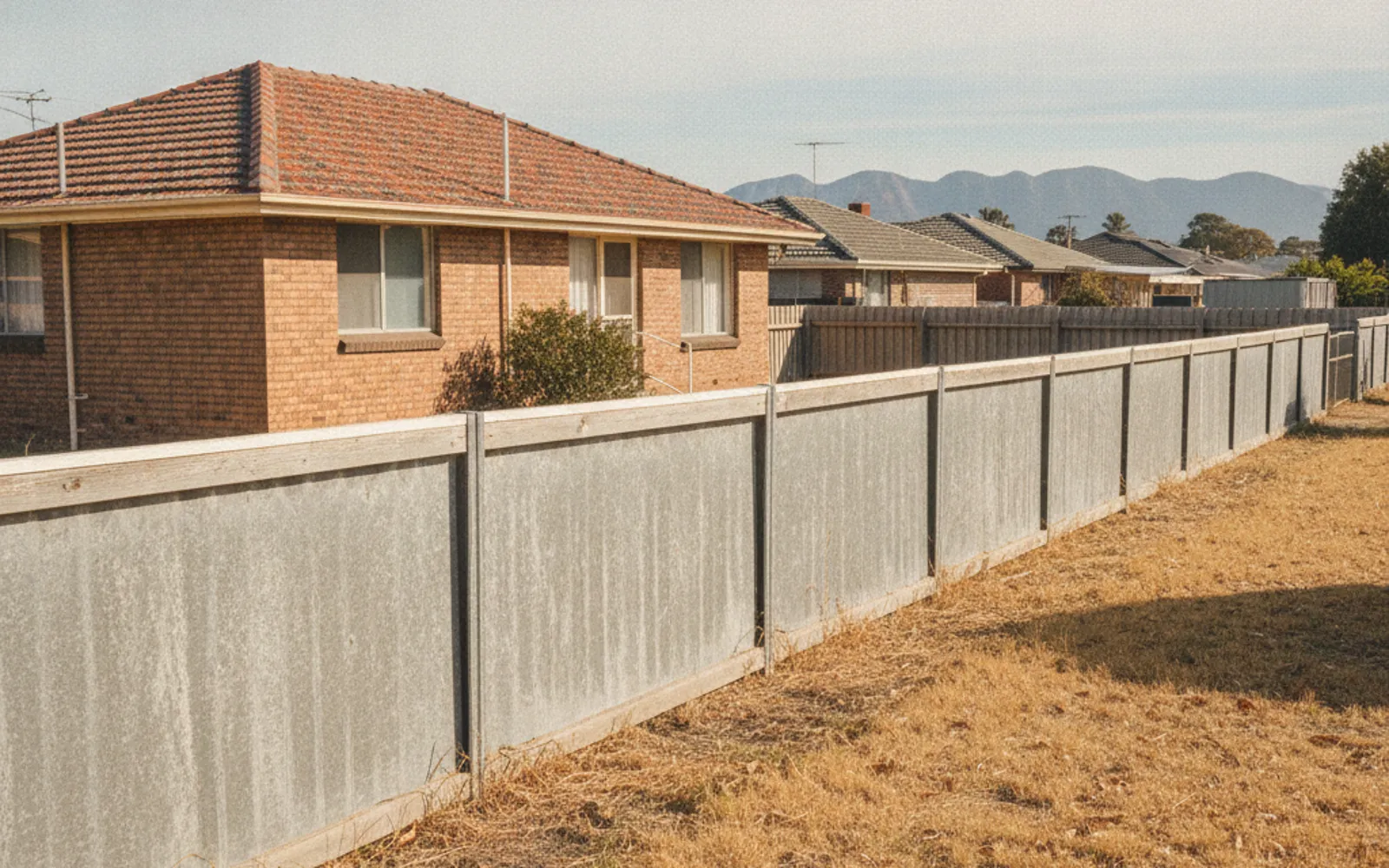
An old fibro boundary fence is the most common asbestos job in Geelong's post-war suburbs. Get it tested before you touch it, then get a written quote from a licensed removalist on 0480 XXX XXX.
Asbestos fence removal in Geelong nearly always starts the same way. A grey sheet in the back boundary fence cracks, a storm lifts one out, the mower clips the bottom edge again, or a renovation plan runs straight into a fence line nobody has looked at closely in forty years. If that fence went up between the mid 1940s and the late 1980s, asbestos cement is a fair assumption until a laboratory says otherwise. The good news is that the first step is cheap.
We do not hold an asbestos removal licence and we do not claim one. Removal is carried out by licensed asbestos removalists we work with, and their WorkSafe Victoria licence number appears on every quote. What we do is help you get the material identified properly and put you in touch with someone who can price the job, so you are comparing real quotes instead of guesses. If you are not certain what you are looking at, start with a test, or call now on 0480 XXX XXX and talk it through first.
A sample analysed by a NATA accredited laboratory is the only way to settle whether a fence is asbestos cement or plain concrete. Published Victorian rates run $88 to $160 per sample.
Asbestos cement sheeting is non-friable, which makes a fence Class B removal work in Victoria. Sheeting that has gone crumbly or been through a fire counts as friable, and friable material is always Class A.
Published Victorian whole fence removal runs $1,000 to $3,500, and most quotes carry a minimum job charge of $800 to $1,500. If a quote is priced per linear metre, ask how that rate was worked out, because no reliable published figure exists.
Sheets go into polythene about 200 microns thick, taped shut and marked with the asbestos warning label before they move. Only one landfill in the whole Barwon region is authorised to receive asbestos.
Above 10 square metres a clearance certificate is required, and where a homeowner engages the removalist directly, the licence holder has to obtain it. It comes from an independent person, so it shows up as a separate line at $165 to $250.
Fence quotes across the post-war streets of Norlane and Corio, the older parts of Ocean Grove and Torquay, and out through Drysdale, Lara and Colac.
Old asbestos cement fences, the ones everyone here calls fibro, are thin cement sheets slotted into grooved posts, usually flat or lightly ribbed, grey when unpainted and chalky where the weather has got at them. Concrete paling fences use the same kind of post but the slabs are much heavier and thicker. Modern fibre cement looks close enough to fibro to fool anyone, which is where most of the confusion comes from, although nothing made after the total ban took effect on 31 December 2003 contains asbestos.
Things that point towards asbestos cement:
None of that is proof, and no honest removalist will give you a yes or no by eye. Only a NATA accredited laboratory can identify asbestos in a sample. Published Victorian rates sit at $88 to $160 per sample, standard turnaround is one to five business days, and a 25 to 50 per cent surcharge buys a result inside 24 to 48 hours. A fence on its own is usually one material and one sample, while a whole house normally needs three to eight, because every different material has to be tested separately.
An intact sheet sitting in the ground is not doing much. The fibres are locked into the cement, which is what non-friable means. The risk turns up when that bound surface is broken open, and forty years of weather off the bay does exactly that. Sheets go chalky, edges crumble, hairline cracks open, and the bottom row gets clipped by the mower and the whipper snipper one summer after another.
That is the real dividing line on a fence job. Sound sheeting is non-friable Class B work. Sheeting that has gone soft and crumbly, or that has been through a fire, is treated as friable, and friable material always goes to a licensed removalist with no exemption at any quantity. Garage roofs of the same vintage weather the same way, so if the Super Six is looking rough as well, see roof removal.
The practical advice is short. Do not cut, drill, sand, smash or pressure wash it. Do not push a leaning fence over to make it easier to load, and do not put broken pieces in the wheelie bin or out with hard waste. If a sheet has already broken, leave the pieces where they are, keep people and pets off that part of the yard, and ring before you tidy up. Plenty of people call us after they have already had a go at it. That is a normal call, not an embarrassing one.
Victoria sets two caps on unlicensed removal of non-friable asbestos, and both have to hold: no more than 10 square metres in total, and no more than one hour of removal work in any seven day period. The hour is cumulative across jobs, not per job. Friable material is never covered by the exemption at all.
Those caps sit in the Occupational Health and Safety Regulations, which bind employers and self-employed people at workplaces. A home is not a workplace, so they do not strictly bind a homeowner working on their own house, and WorkSafe's compliance code recommends that homeowners follow the same rules anyway. The moment a tradesperson, a tenant, a rental property, a business premises or a paid helper is involved, those caps are law. You will read elsewhere that it is illegal for a homeowner to take down more than 10 square metres at home. That is not what the regulations say, and getting it wrong in either direction helps nobody.
A full boundary fence is well past 10 square metres and well past an hour either way, which is the honest reason it goes to a licensed removalist rather than a weekend. Two things follow from the size of the job:
Published Victorian figures put whole fence removal at $1,000 to $3,500, with a minimum job charge of $800 to $1,500 that swallows anything small. Per sheet rates of $20 to $50 only mean something read against that minimum, so a four sheet repair does not cost $120. These are published Victorian ranges rather than our quotes, most of them come from Melbourne operators, and several of those price regional work separately. Treat them as a benchmark for the conversation, ask each removalist whether their quote includes GST because the treatment varies, and see the cost guide for the rest of it.
A boundary fence is shared, and dividing fences between neighbours in Victoria sit under the Fences Act 1968. The Act works on the idea that adjoining owners contribute to a sufficient dividing fence, and on written notice between neighbours before the work happens. We are not lawyers and this is not legal advice, so raise it early, put it in writing, and use the free Dispute Settlement Centre of Victoria if you cannot agree. In practice the conversation goes better with a laboratory result and a written removal quote in hand than with two opinions about an old fence.
We do not quote, price or carry out the fence that replaces it, and a removalist's quote should not include it either. Removal finishes when the old sheeting is wrapped, taken to an authorised landfill and the ground is left clear. The new fence is a separate job, between you and a fencing contractor or a registered builder, and most people around here go to Colorbond or treated pine palings. Keeping the two apart also makes the neighbour conversation simpler, because what the removal costs and what the new fence costs are different questions.
Published Victorian ranges put a whole fence at $1,000 to $3,500, and most removalists carry a minimum job charge of $800 to $1,500, so even a small patch costs close to a full call out. Per sheet rates run about $20 to $50, which only makes sense read against that minimum. These are published Victorian figures rather than our quotes, mostly from Melbourne operators who price regional work separately. GST treatment varies between providers, so ask whether a quote includes it.
The 10 square metre and one hour in seven days limits are what the law sets for anyone doing asbestos removal as work, and those regulations bind workplaces rather than a homeowner at their own home. WorkSafe recommends homeowners follow the same code anyway, and the limits become law the moment a tradesperson, a tenant, a rental property or a paid helper is involved. A full fence line is past both limits regardless of who does it. Anything crumbling or friable is Class A work with no exemption at any size.
Only a NATA accredited laboratory can identify asbestos in a sample, and nobody can do it by eye. Published Victorian rates are $88 to $160 per sample, standard turnaround is one to five business days, and a 25 to 50 per cent surcharge buys a 24 to 48 hour result. A fence on its own is usually a single sample, while a whole house inspection normally needs three to eight because each different material is tested separately.
It has to go to a landfill authorised to receive asbestos, and there is exactly one in the Barwon region: Drysdale Landfill, on (03) 5251 2935. It takes small domestic quantities only, up to a 6x4 trailer, fees apply, and you have to ring before you turn up. Drysdale does not publish its asbestos fee, and other Victorian councils publish gate fees anywhere from $100 to $376 per tonne, none of them Geelong. Sheets have to be wrapped in polythene about 200 microns thick, taped shut and carrying the asbestos warning mark before they are transported.
A clearance certificate is not required where the work involved only non-friable material of 10 square metres or less, and a full fence line is normally well past that. Above that threshold the certificate is required, and where a homeowner has engaged the removalist directly, the duty to obtain it sits with the licence holder rather than with you. It has to come from an independent person with no interest in the job, which is Victoria's term for the role. Published Victorian pricing for a clearance certificate is $165 to $250.
Free quotes from licensed removalists. Tell us what you've found and we'll put you in touch.